A buyer’s guide to branded jackets, waterproof (mm) and breathability ratings — how to choose by budget and use.
Fleece, 2-Layer or 3-Layer Softshell? A Buyer’s Guide to Branded Jackets and Waterproof Ratings
The DongLian team supports OEM workwear and jacket programs for international buyers, from specification review and sample development to bulk and private-label orders.
If you are planning a jacket for a promotion, a staff uniform or a private-label line, two questions decide almost everything: how much do you want to spend, and does the jacket need to keep out water?
Most bulk jacket orders end up as one of three types: fleece, 2-layer softshell or 3-layer softshell. This guide explains what each one does, how to read the waterproof and breathability numbers on a spec sheet, and how to pick the right level without overpaying.
Quick Guide: Which Jacket Type?
| Your priority | Choose | Warmth | Water protection | Price level |
|---|---|---|---|---|
| Lowest price, warm, great for logos | Fleece jacket | High | None | $ |
| Warm, plus wind and light-rain protection | 2-layer softshell | Medium–High | Water-resistant | $$ |
| High quality, waterproof and warm | 3-layer softshell | High | Waterproof (membrane) | $$$ |
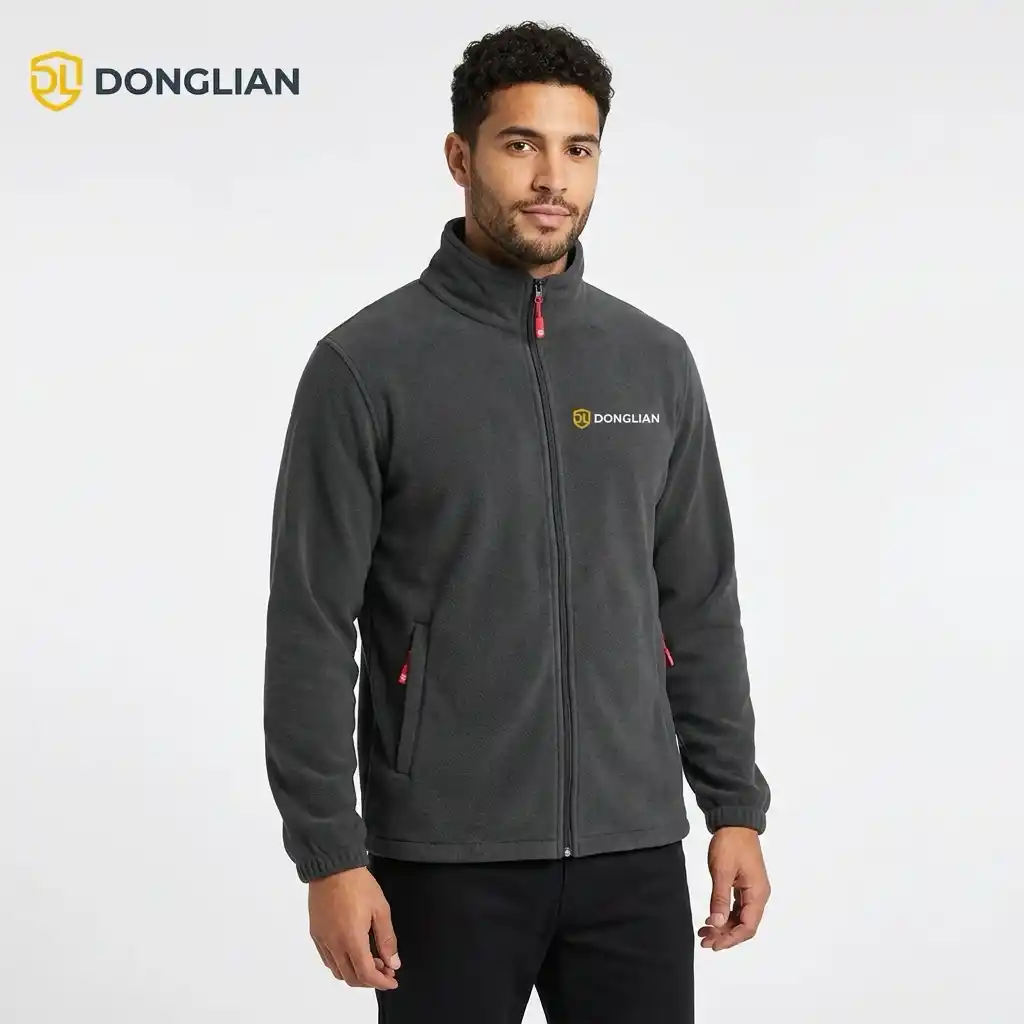
330 GSM fleece, full zip. Warm, soft, ideal for embroidery and promotions.
View DL3054 →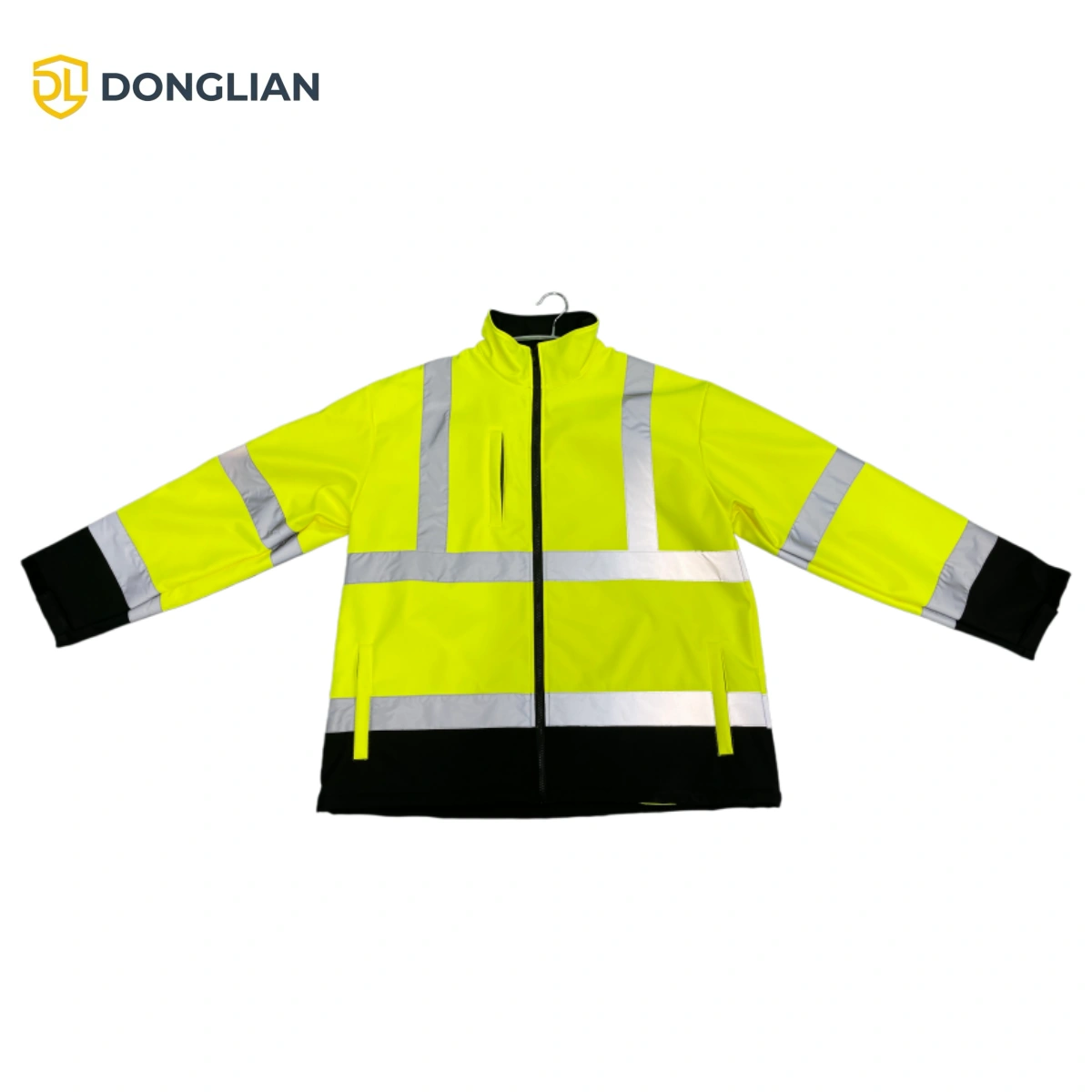
Woven shell bonded to fleece, DWR outer. Wind-blocking and shower-resistant.
View DL1431 →
Waterproof breathable membrane between shell and fleece, with zip-off sleeves.
View DL3058 →1. Fleece Jacket: The Budget Choice for Promotions
If you want the best value on a large quantity, start with fleece. It is warm, soft and comfortable, and the surface takes embroidery very well, so your logo looks sharp and survives repeated washing. For giveaways, corporate gifts, staff uniforms and seasonal promotions, fleece gives your customers a quality feel at a price that protects your margin.
Examples: DL3054 Solid Fleece Work Jacket (330 GSM, full zip) and DL25325 Hi-Vis Lined Fleece Jacket. You can compare fleece and other insulated styles in our Winter Workwear collection.
The limit of fleece is water. It offers no real protection from rain. If your users work or travel outdoors in wet weather, move up to a softshell.
2. 2-Layer Softshell: Wind and Light-Rain Protection
A 2-layer softshell bonds a woven outer fabric to a soft fleece lining, usually with a water-repellent finish or coating on the outside. It blocks wind, sheds showers and light rain, and stays warm and flexible. The price is a little higher than fleece.
It suits people who are active, who need some weather protection, and whose budget is still a concern. Example: DL1431 Softshell Jacket. Plain and hi-vis softshell styles are included in our Outdoor Workwear collection.
3. 3-Layer Softshell: High Quality, Waterproof and Warm
A 3-layer softshell adds a waterproof, breathable membrane between the outer fabric and the fleece lining. You get warmth, wind protection and waterproofing in one garment, with a more premium look and feel. It is the right choice for buyers who want a high-quality jacket that works in real rain.
Examples: DL1430 and DL3058 with zip-off sleeves. Certified hi-vis versions can be found in our Hi-Vis Safety Wear collection.
Logo tip for 3-layer softshells: heavy direct chest embroidery can puncture the inner waterproof membrane, which may let water seep through the needle holes. For jackets where waterproofing matters, heat-transfer logos or sleeve patches are the safer option — tell us your logo method at sampling and we will check the placement with you.
Waterproof and Breathability Ratings, Explained
When you compare softshell jackets, two numbers appear on almost every spec sheet.
Waterproof rating (mm). This comes from a lab test that measures how tall a column of water the fabric can hold before water pushes through. A higher number means better resistance to water pressure.
Breathability (g/m²/24h). This measures how much water vapor, meaning sweat, passes out through the fabric in 24 hours. A higher number means the wearer stays drier and cooler inside the jacket.
Here is a practical way to read them:
Waterproof rating in use
| Waterproof rating | What it means in use |
|---|---|
| Under about 1,500 mm | Water-resistant: handles drizzle and short showers |
| About 3,000 mm | A solid everyday level for light-to-moderate rain; enough for most work and uniform use |
| About 5,000 mm | Better for longer time outdoors and heavier rain |
| 10,000 mm and above | For harsh, prolonged wet conditions; higher cost, and more than most workwear needs |
Breathability in use
| Breathability | What it means in use |
|---|---|
| About 1,500 g/m²/24h | Comfortable for light-to-moderate activity |
| About 3,000 g/m²/24h | Suitable for active work and long hours outdoors without feeling stuffy |
| Higher | For intense activity; adds cost |
Three things are worth knowing before you set a spec:
- Higher is not always better. Waterproofing and breathability pull against each other, and both add cost. Match the number to how the jacket will really be used.
- A common sweet spot is about 3,000 mm waterproof with about 1,500 g/m²/24h breathability. It covers everyday use at a sensible price.
- For long outdoor activity, step up to 5,000 mm waterproof and 3,000 g/m²/24h breathability. Waterproofing keeps the rain out, and the better breathability keeps the wearer from overheating over a long day.
The fabric rating is not the whole jacket. Seams, zippers and pockets decide how well the finished garment keeps water out, so ask for the construction details as well as the number.
Reflective Tape: Add It or Leave It Out
For promotional and branded programs, reflective tape is a design choice. It can go on the body, the sleeves or both, or be left off for a cleaner look. You do not need to worry about meeting a European or American standard if your project does not require one.
If the jackets will be worn as safety garments where hi-vis is mandatory (roadwork, rail, construction sites), certification is required and we should specify it from the start. If your tender or market requires certified high-visibility garments (for example EN ISO 20471 or ANSI/ISEA 107), tell us at the beginning — that is a separate specification with its own testing. See our comparison of ANSI/ISEA 107 vs EN ISO 20471 for the key differences.
Custom-Made to Your Requirements
- Logo: embroidery, screen print or heat transfer, plus woven labels and hangtags.
- Color: colors can be custom made, with Pantone matching.
- Fabric performance: waterproof and breathability levels can be made to your target, for example the 5,000 mm / 3,000 g/m²/24h level above.
- Reflective tape: with or without, in the layout you prefer.
MOQ and Samples
Our standard MOQ is 1,000 pieces. Special colors and trial orders can be discussed. For common colors such as navy, black, hi-vis yellow and hi-vis orange-red, quantities can often be combined to reach the MOQ, so tell us what you need and we will work out a way.
Samples are free. The customer covers the shipping cost. A sample usually takes one to two weeks, and you approve it before bulk production begins.
Frequently Asked Questions
No. Fleece is warm and comfortable, but it does not protect against rain. Choose a softshell for wet conditions, or wear fleece as a mid-layer under a rain jacket.
A 2-layer jacket has a water-repellent outer fabric bonded to fleece. A 3-layer jacket adds a waterproof, breathable membrane in the middle, so it keeps out rain much more effectively.
For most work and uniform use, about 3,000 mm is enough. For long outdoor activity, consider 5,000 mm with higher breathability.
Yes. Logo, colors and performance levels can all be custom made — including embroidery, screen print, heat transfer, woven labels, hangtags and Pantone-matched shell colors.
Our standard MOQ is 1,000 pieces. Special colors and trial orders can be discussed, and common colors can often be combined. Samples are free; the customer covers shipping.
Ready to Start Your Jacket Program?
Send us your target quantity, jacket type and logo, and we will quote and arrange your free sample.