How to Find and Vet Certified Rainwear Suppliers
For Government PPE Contracts
How to Find and Vet Certified Rainwear Suppliers for Government PPE Contracts
Bidding on or fulfilling a government protective apparel contract—whether for transportation departments, municipal public works, or emergency agencies—requires strict compliance. In government procurement, an unverified test report, incorrect wash label, or country-of-origin mismatch can quickly disqualify your bid or delay contract delivery.
Finding rainwear suppliers online is quick. The real challenge is verifying whether a manufacturer can actually produce garments to your tender’s exact technical, legal, and delivery requirements.
This practical guide shows procurement managers, government contractors, PPE distributors, and importers how to locate, evaluate, and qualify rainwear manufacturers before issuing purchase orders.
1. Start With the Contract Requirements
A common mistake is searching for suppliers before fully breaking down the tender specification. Never ask a supplier “what certifications they have” until you know your contract’s exact technical metrics.
Map your contract solicitation into clear verification checkpoints:
| Tender Requirement Category | What to Verify With the Supplier |
|---|---|
| High Visibility | ANSI/ISEA 107 compliance (Class 2, Class 3, or Type R/P) |
| Flame Resistance (FR) | ASTM D6413 or specified FR standards (if required by contract) |
| Waterproofing & Weather Protection | Hydrostatic pressure rating, coating type (PU/PVC), and seam sealing |
| Reflective Tape | Tape width, retroreflective performance, and placement |
| Labeling & Markings | Wash care labels, sizing standards, and warning markings |
| Country of Origin | Domestic-preference or trade agreement requirements |
Focus on Applicable Standards Only
Do not assume every rainwear tender requires multiple certifications. Standards depend entirely on end-use applications (e.g., ANSI/ISEA 107 for high-visibility traffic zones, or ASTM D6413 for vertical flame resistance). Always cross-reference your contract’s required standard version against the supplier’s test reports, and avoid paying extra for unrequested certifications unless specified in the tender.
2. Where to Find Qualified Rainwear Manufacturers
To build a reliable candidate list, focus on suppliers with established industrial workwear capability:
- Specialized Industrial Rainwear Manufacturers: Focus on factories dedicated to technical protective apparel and waterproof seam-sealed outerwear rather than general consumer apparel suppliers.
- PPE Distributors’ Sourcing Networks: Established supply partners with pre-vetted factory chains.
- B2B Sourcing Platforms: Trade portals filtering qualified rainwear manufacturers with ISO 9001 quality management systems.
- Industry Referrals & Trade Shows: Recommendations from experienced government contractors and industry partners.
Finding candidates takes a few clicks. The real work begins with qualifying their actual manufacturing capability.
3. How to Verify PPE Test Reports & Garment Compliance
Relying on a single-page certificate or an expired summary sheet is a major procurement risk. A valid certificate without a complete lab report offers little protection during a contract audit.
Verify the Complete Lab Report
- Request Full Reports: Inspect multi-page lab reports for exact test methods, detailed parameters, and actual sample photographs.
- Check Laboratory Scope: Confirm that the testing laboratory is accredited to ISO/IEC 17025 for the relevant test methods.
- Trace Report Authenticity: Use the lab’s online database or contact them directly to confirm report numbers, applicant names, and issue dates match.
Fabric Testing vs. Finished Garment Compliance
A frequent point of confusion is assuming a fabric test report qualifies the entire garment.
A fabric-only ASTM D6413 report proves the raw material resists ignition, but it does not cover heat-transferred reflective tape, zippers, drawstrings, or seam-sealing tapes used in the finished rainsuit. Always verify that test reports match the exact style number, fabric weight, and finished garment construction you are purchasing.
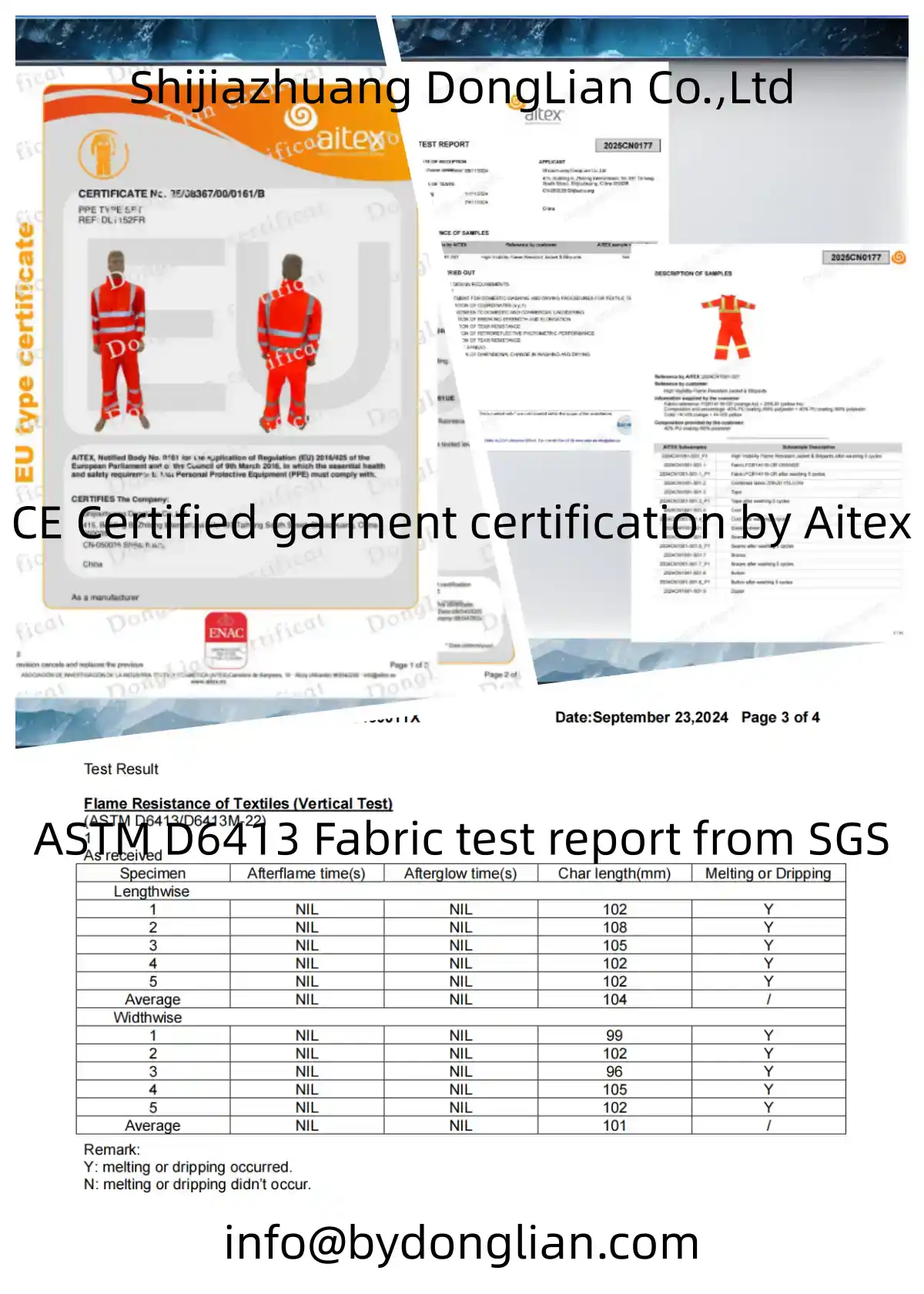
A raw fabric test report proves textile properties (e.g., ASTM D6413), while finished garment compliance covers reflective tape, seams, zippers, and applicable labeling.
4. Check Country of Origin and Contract Requirements
If domestic-preference or trade agreement requirements apply to your contract, verify the applicable country-of-origin rules in the solicitation before selecting a supplier.
- Trade Agreement Requirements: If trade agreement requirements apply to the contract, verify whether the product and its country of origin meet the applicable solicitation requirements specified by the purchasing agency.
- Commercial Subcontracts & Non-Domestic-Preference Tenders: For subcontracts or commercial tenders without strict domestic restrictions, sourcing directly from a direct rainwear manufacturer offers significant cost efficiency—provided technical specs are fully met.
- Origin Verification: Always ask the supplier for written country-of-origin information and confirm it directly against your solicitation requirements before placing bulk orders.
5. Evaluate the Factory Behind the Supplier
Whether working with a specialized industrial rainwear manufacturer or a trading partner, you need visibility into the actual production facility. A supplier may hold valid test reports but lack the machinery or capacity to deliver on time.
Key Operational Factors to Audit
- Seam-Sealing Machinery: Ensure the factory operates dedicated hot-air seam-sealing machines and pressure testing equipment to prevent water leakage.
- Quality Control Systems: Confirm the supplier’s inline quality control procedures and agreed pre-shipment inspection standard, such as an AQL-based inspection (e.g., AQL 2.5/4.0) where appropriate.
- Realistic Lead Times: Evaluate raw material lead times and monthly production output against your delivery deadline.
Direct Rainwear Manufacturer vs. Trading Partner
A qualified trading company can be a suitable supplier if they maintain transparent factory partnerships and quality oversight. However, for large government tenders, buyers should know who actually manufactures the garments:
| Evaluation Criteria | Direct Rainwear Manufacturer | Trading Partner / Intermediary |
|---|---|---|
| Factory Visibility | Direct access to machinery and production lines | Indirect visibility; requires sub-supplier tracing |
| Customization & OEM | Direct technical communication with pattern makers | Dependent on third-party factory flexibility |
| Quality Oversight | Direct in-house quality control management | Varies based on intermediary’s inspection process |
| Production Control | Direct scheduling and line allocation control | Dependent on sub-contracted factory availability |
6. 8 Questions to Ask a Rainwear Supplier Before Awarding a Contract
Before issuing a deposit, ask your prospective supplier these eight targeted questions:
- 1“Can you provide full, multi-page test reports matching our tender’s exact ANSI/ASTM standards?”
- 2“Do your test reports cover the finished garment construction or fabric swatches only?”
- 3“Which manufacturing facility will produce this order, and can we review their factory documentation?”
- 4“Can you provide a country-of-origin declaration for the specific product and production site?”
- 5“What seam-sealing technology and waterproofing ratings do you guarantee for bulk production?”
- 6“What is your factory’s realistic monthly output capacity for technical rainwear?”
- 7“Can you customize heat-transfer wash labels to comply with applicable labeling requirements?”
- 8“What inspection system (e.g., AQL 2.5) is used before bulk shipment?”
7. Red Flags When Choosing a Rainwear Supplier
Watch for these common warning signs during supplier evaluation:
- Red Flag 1: Supplier provides only a single-page summary certificate instead of a complete lab report.
- Red Flag 2: Test reports cover raw fabric only, but the supplier claims the finished garment is certified.
- Red Flag 3: Test reports omit style numbers, fabric descriptions, or clear sample photographs.
- Red Flag 4: Supplier cannot identify the specific factory producing the order.
- Red Flag 5: Supplier claims general “CE Compliance” without showing compliance with the project’s applicable ANSI/ASTM or required specifications.
- Red Flag 6: Supplier promises unrealistically short lead times without explaining their production capacity.
8. Documents to Request & Quick Evaluation Checklist
Before placing a purchase order, request the following document package from your supplier:
- Complete Third-Party Test Reports (e.g., ANSI/ISEA 107, ASTM D6413) matching your tender’s specifications.
- Factory ISO 9001 or Social Audit Reports (e.g., BSCI, SMETA). Note: These documents help evaluate factory management and social compliance, but they do not replace product-specific testing required by the contract.
- Technical Data Sheets (TDS) specifying fabric weight, PU/PVC coating specs, waterproof ratings, and reflective tape details.
- Country of Origin Declaration matching solicitation requirements.
- Pre-Production Samples with correct wash labels attached.
Quick Supplier Evaluation Checklist
Use this practical checklist to quickly compare candidate suppliers:
- Test reports independently verified with issuing lab
- Finished garment specification matches tested sample
- Manufacturing facility identified and evaluated
- Monthly production capacity confirmed for tender volume
- Quality control inspection system (AQL) documented
- Country of origin verified against contract rules
- Pre-production sample approved prior to bulk order
Frequently Asked Questions (FAQ)
Partner With a Specialized Industrial Rainwear Manufacturer
Sourcing rainwear for a government contract requires a manufacturing partner who understands technical specifications, seam construction, and delivery schedules.
At PURAINGEAR (Shijiazhuang DongLian Co., Ltd.), we specialize in OEM/ODM manufacturing of technical industrial rainwear, high-visibility safety wear, and FR protective outerwear. We support prime contractors, PPE distributors, and importers with direct factory manufacturing, seam-sealed construction, physical product samples, and product-specific technical documentation and third-party test reports for evaluation.
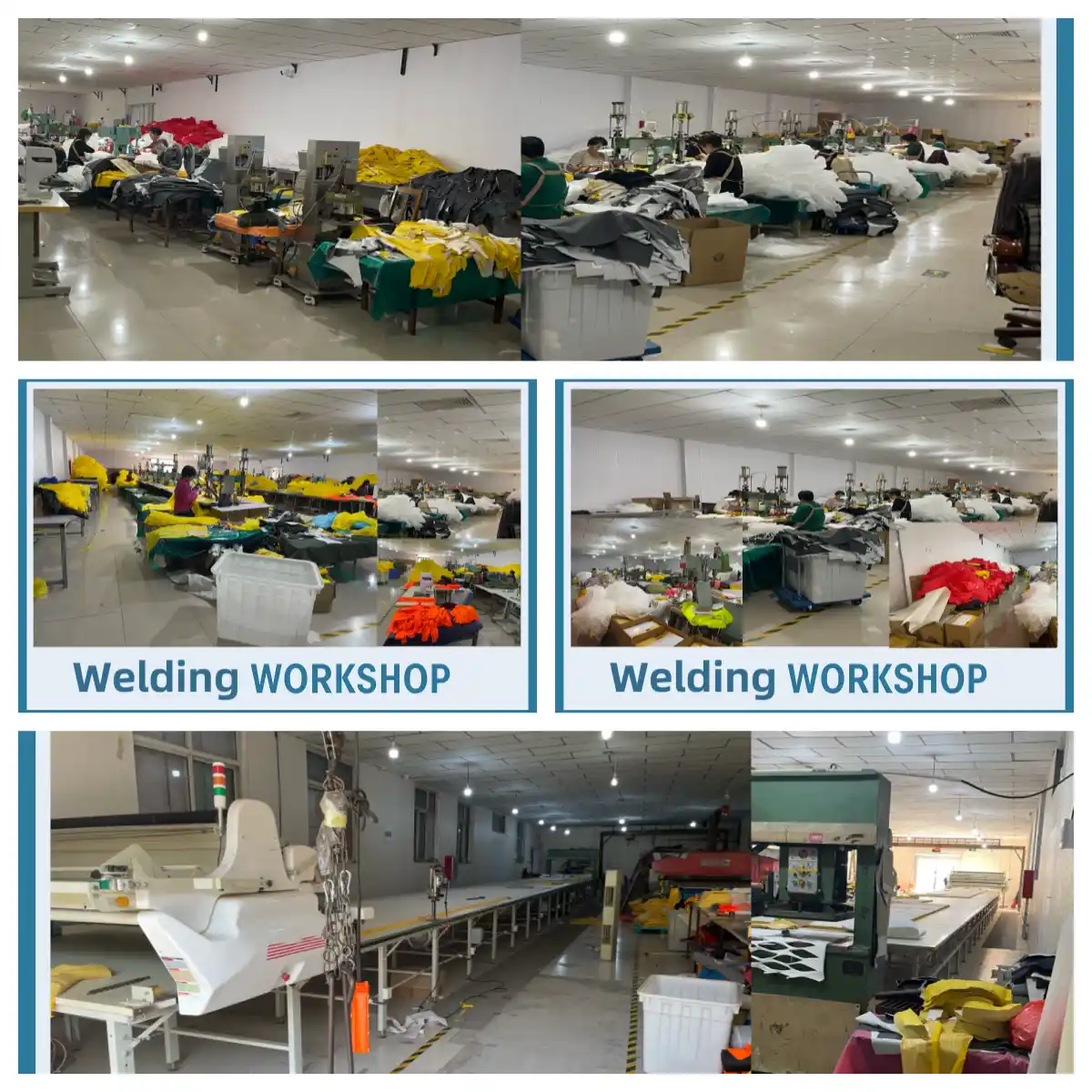
Our seam-sealing machinery workshop at Shijiazhuang DongLian Co., Ltd., ensuring waterproof integrity for technical rainwear.
Have a PPE project or rainwear sourcing requirement?
Send us your product specifications, target quantity, or tender requirements. Our technical sourcing team will review your needs and provide suitable samples, technical documentation, and test reports for your evaluation.