How to Read an EN ISO 14116 Test Report Before Buying FR Rainwear
You’re comparing two quotations for the same FR rainwear project. Both suppliers claim EN ISO 14116 compliance. One attaches a single-page certificate. The other shares a complete laboratory report with full garment certification. Which supplier would you feel more confident approving?
For purchasing managers, category buyers, and distributors, reading a test report isn’t about understanding textile engineering — it’s about protecting your bottom line, ensuring worker safety, and making informed supplier evaluations. Here is a practical guide to decoding an EN ISO 14116 test report and understanding what those laboratory numbers mean for your procurement decisions.
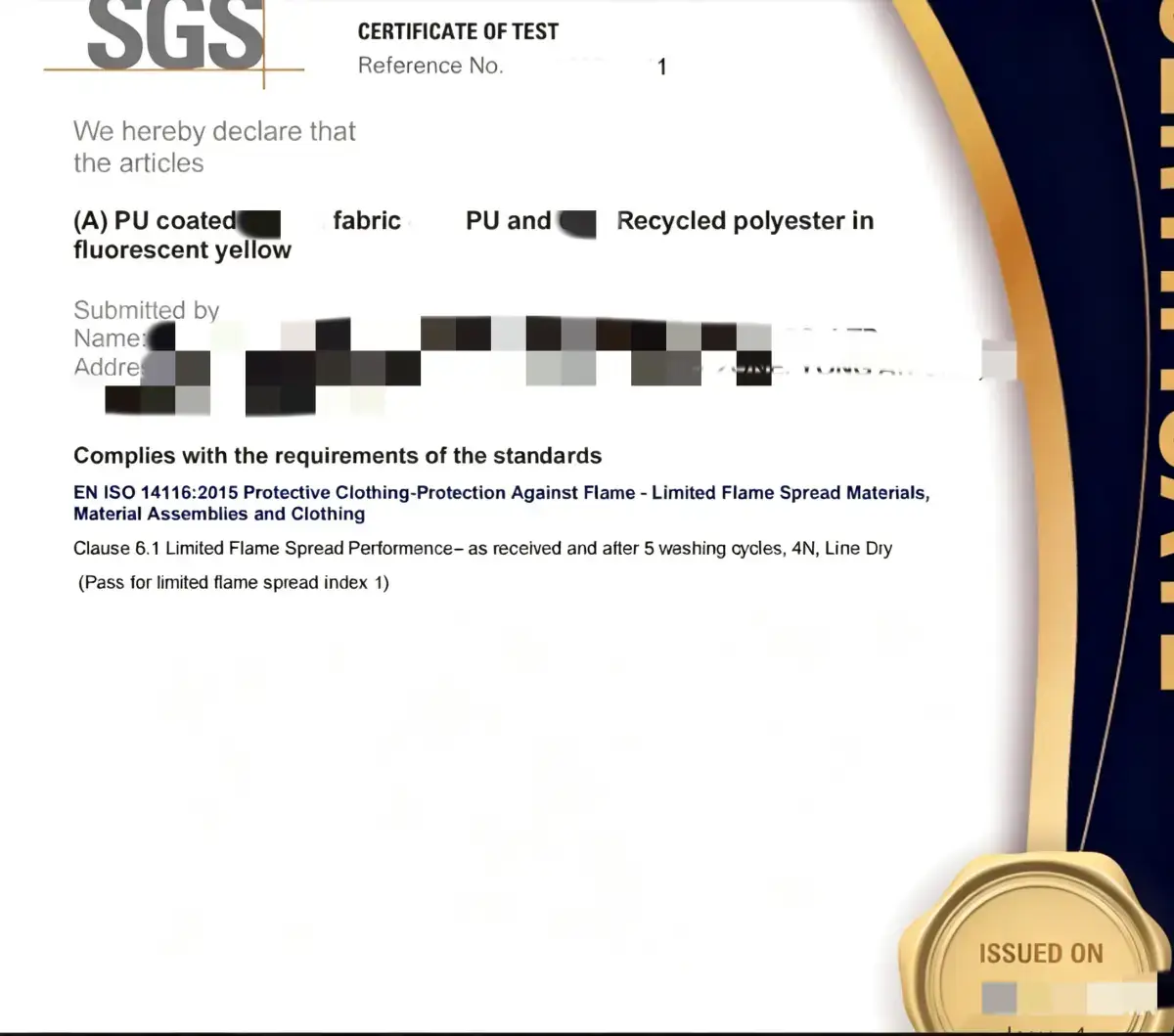
1. Should Buyers Worry if FR Rainwear Only Achieves Index 1?
When you look at an EN ISO 14116 report, the most prominent rating is the Limited Flame Spread Index (Index 1, 2, or 3). Many buyers see “Index 1” and wonder if it indicates a lower level of protection. For waterproof PU rainwear, Index 1 is often exactly what you want to see.
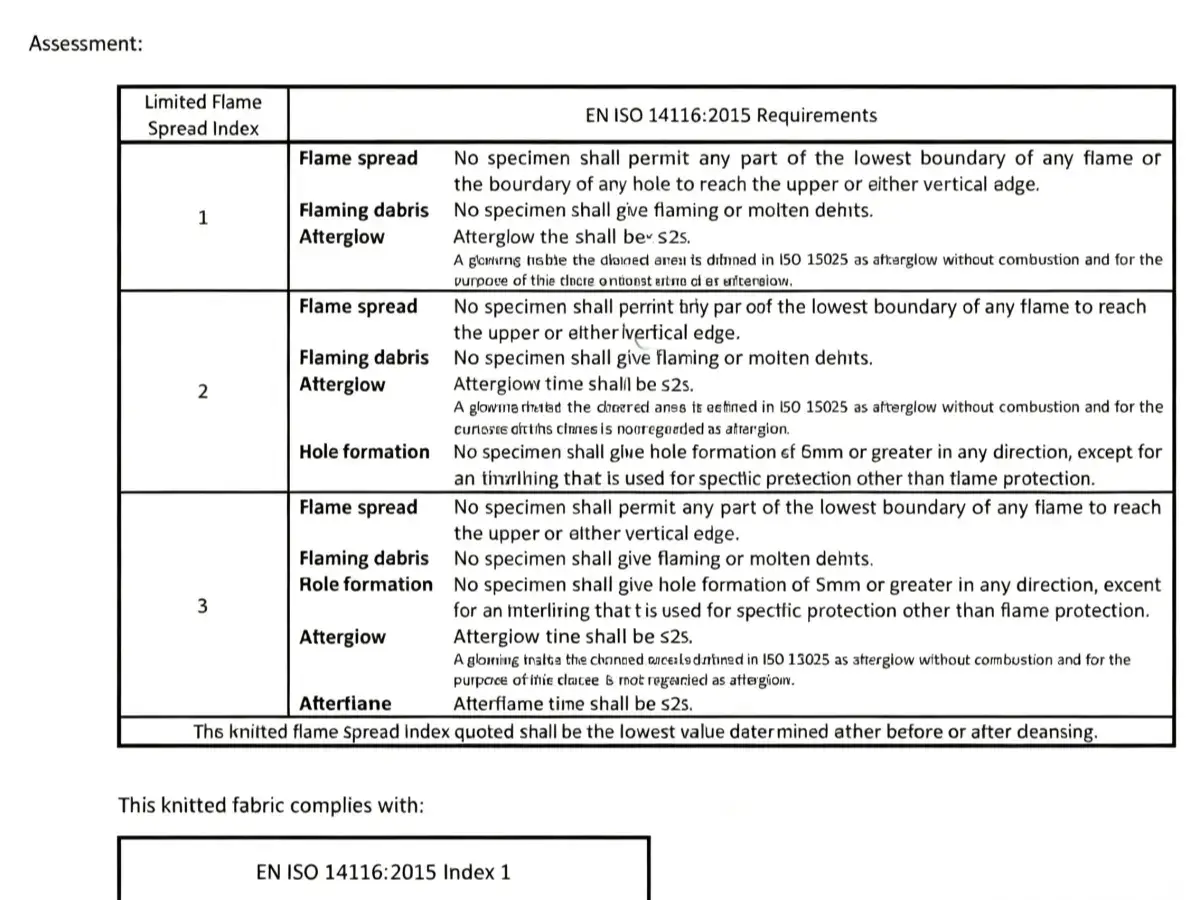
Index 1 materials prevent the spread of flames and do not produce burning debris. PU coatings are specifically designed to be waterproof — when touched by a small flame or spark, high-quality PU shrinks back and self-extinguishes. This guarantees compliance for environments with occasional spark risks without sacrificing the garment’s primary wet-weather performance.
2. Does Burst Strength Affect Product Lifespan?
FR standards are not exclusively about fire resistance — they also evaluate mechanical durability. A rain suit that protects against sparks but fails under physical stress is a poor investment. This is why laboratory reports include Burst Strength testing (EN ISO 13938-1).
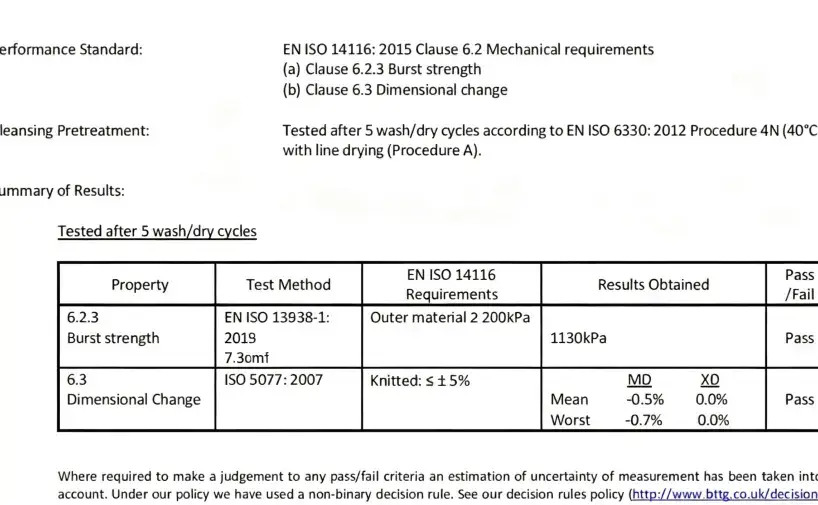
EN ISO 14116 requires knitted materials to achieve at least 200 kPa burst strength after washing. High-quality FR rainwear fabrics often achieve results significantly above the minimum — sometimes reaching 1130 kPa. Higher burst strength indicates the fabric is more resistant to tearing and physical stress during demanding daily use, directly contributing to a lower Total Cost of Ownership (TCO) for distributors and project managers.
3. Will the Garment Maintain Its Fit After Repeated Washing?
Another critical section is ISO 5077 — Dimensional Change. It measures how the material behaves after industrial laundering cycles. The standard limits dimensional change (shrinking or stretching) to ±5%.
Premium fabrics often register minimal changes — such as -0.5% in the machine direction and 0.0% in the cross direction, as shown in the BTTG report above. If cheap PPE shrinks by 5% after a few washes, it becomes uncomfortable and potentially non-compliant due to exposed skin. Stable dimensions mean fewer end-user complaints and easier size management for your inventory.
“An EN ISO 14116 certificate tells me everything I need to know.” Not necessarily. The certificate confirms compliance, while the underlying laboratory report provides additional information about how the material actually performed during testing. Reviewing both documents together gives buyers a more complete picture — and stronger documentation for tenders and audits. See our guide on garment certification vs. fabric testing for more on this distinction.
4. Red Flags When Reviewing Test Reports
When comparing quotations side by side, watch for these warning signs that may indicate procurement risk:
- The certificate covers only the fabric, while the quotation is for a finished garment — garments require their own certification to ensure seams, zippers, and reflective tapes are compliant
- The report references a different color or fabric weight from the quoted product
- Only a single-page certificate is provided and the supplier refuses or hesitates to share the detailed laboratory report
- The test date is several years old and may not reflect current manufacturing batches
- The supplier cannot explain which test report corresponds to which specific product in their catalog
5. Quick Procurement Checklist
Before approving an FR rainwear supplier, verify that you can answer “Yes” to each of these:
- Is the test report issued by an accredited laboratory (e.g., SGS, BTTG, AITEX)?
- Does the report match the quoted product exactly — same model, color, fabric weight?
- Are the test dates still valid and representative of the current batch?
- Is the garment certified, or was only the fabric tested?
- Can the supplier explain the report clearly and answer specific questions about the results?
Evaluating FR Rainwear Suppliers?
We can share our full test report package — SGS ASTM D6413 report, BTTG EN ISO 14116 report, and AITEX garment-level certificate — so you can see exactly what complete documentation looks like.
Request an RFQ